Can You Drink Tap Water in London? Safety, Quality and FAQs
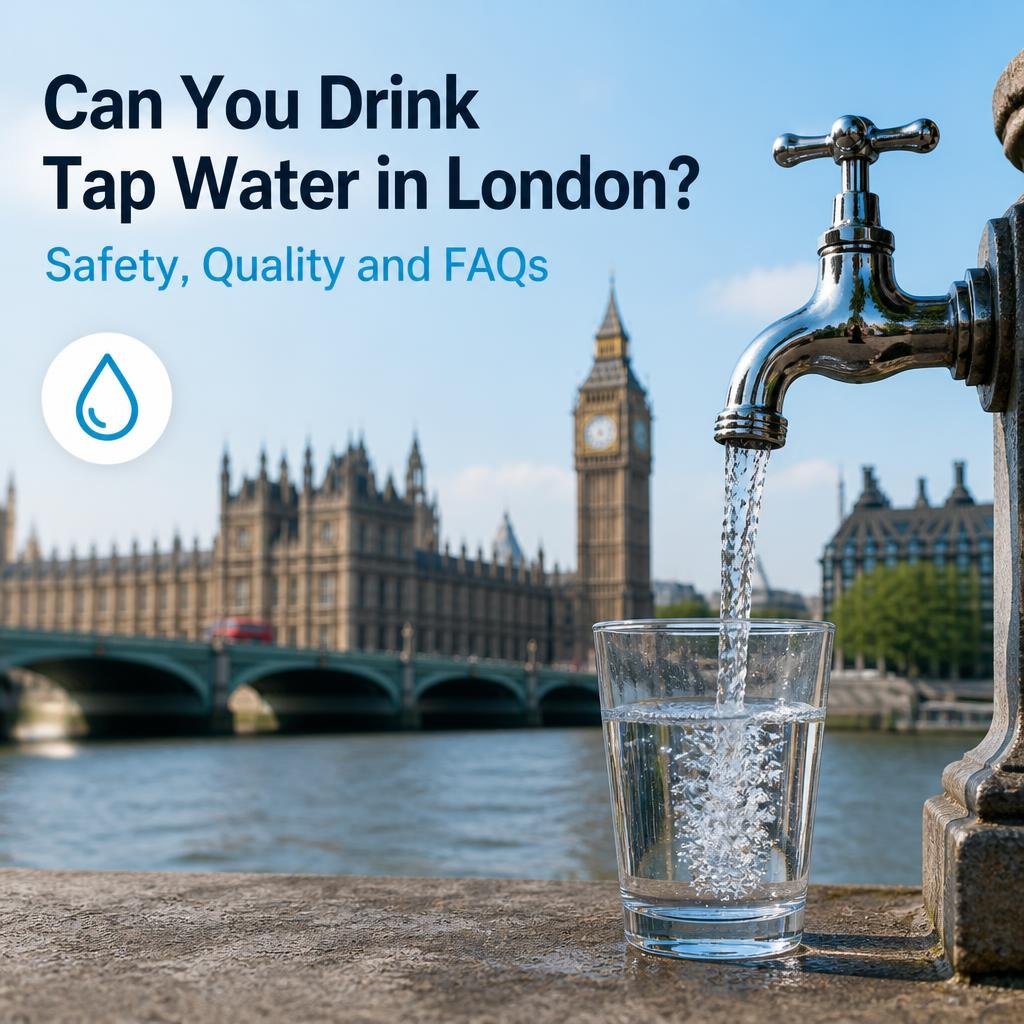
Yes, you can drink tap water in London. London’s public drinking water is treated, tested and regulated before it reaches homes, hotels, restaurants and businesses. For most residents and visitors, there is no need to buy bottled water for safety reasons.
But London’s tap water has a reputation that often raises questions. Where does it actually come from? Is water from the River Thames safe to drink? Why does London have hard water? Does tap water contain chlorine? Is bottled water healthier? And how does London’s water quality compare with the rest of the UK?
This guide answers those questions and explains what you need to know about drinking tap water in London.
Key facts about London’s tap water
| Question | Short answer |
|---|---|
| Can you drink tap water in London? | Yes |
| Is London tap water safe? | Yes, when supplied through the public mains |
| Where does it come from? | Mainly the River Thames, River Lee and groundwater |
| Does London have hard water? | Yes — London has relatively hard water |
| Does it contain chlorine? | Yes, small amounts are used for disinfection |
| Can tourists drink it? | Yes |
| Can you drink untreated Thames water? | No |
| Do you need bottled water? | No, not for safety reasons |
| Is there a reliable current figure for the percentage of Londoners drinking tap water? | Not one that should be presented as a definitive London-wide statistic |
Is tap water in London safe to drink?
Yes. London tap water is considered safe to drink and is subject to regulatory standards and extensive testing.
The Drinking Water Inspectorate (DWI), the independent regulator for drinking water quality in England and Wales, oversees public drinking-water supplies. Thames Water is London’s largest water supplier and serves more than 10 million people across its wider supply area. The DWI currently records 106 treatment works, 419 service reservoirs and around 31,750 kilometres of water mains within the Thames Water supply area.
The Mayor of London’s office has also stated that Thames Water carries out more than 500,000 drinking-water tests each year, taking samples from reservoirs, water mains and customers’ taps. According to the London Assembly, more than 99.95% of customer-tap tests have met the required standards since 2010.
This means that, for the average London resident or visitor connected to the public mains network, turning on the cold tap and filling a glass is a normal and safe way to get drinking water.
Does that mean every individual tap is guaranteed to be perfect?
No water system should be described as completely risk-free.
Water quality can occasionally be affected by incidents in the wider network or by the plumbing within an individual building. Older properties, for example, can have ageing internal pipework that may affect water quality.
This is why drinking-water regulation considers not only water leaving treatment works but also water sampled at consumers’ taps.
The DWI publishes detailed water-quality monitoring data for Thames Water. Its consumer-tap testing includes parameters such as metals, colour, taste, odour, turbidity, pH and microbiological indicators.
So the professional answer is not simply “London tap water is perfect.” It is more accurately:
London’s public drinking-water supply is treated, monitored and regulated to ensure it is safe for consumption, although occasional localised problems can occur and building plumbing can also influence water quality.
Where does London’s tap water come from?
London’s water does not come from a single source.
The city’s supply is based primarily on surface water and groundwater.
According to Thames Water’s 2024 Water Resources Management Plan, London’s water supply is predominantly based on surface-water abstractions from the River Thames and River Lee, which are stored in large reservoirs before being treated. Groundwater sources also contribute to the supply.
The Drinking Water Inspectorate currently describes the wider Thames Water supply area as approximately:
- 75% surface water
- 25% groundwater
It is important to note that these figures refer to the Thames Water supply area, not necessarily every individual London borough or every day of the year. The precise source mix changes according to location, rainfall, reservoir levels, demand and operational requirements.
London’s water supply at a glance
For London specifically, Thames Water says the London Water Resource Zone is supplied mainly by surface water, with water from the Thames and River Lee stored in reservoirs before treatment.
Does London’s tap water come from the River Thames?
Partly, yes.
The River Thames is one of the most important sources of London’s drinking water. Water is abstracted from the river, stored and then sent to treatment works.
The River Lee is another important source.
This often leads to a common misconception: if the Thames is used as a drinking-water source, does that mean people are drinking water directly from the river?
No.
The water in the river is raw source water. It undergoes extensive treatment before it becomes drinking water.
Thames Water explicitly explains that raw water from rivers and reservoirs is not safe to drink before treatment. Water is pumped to treatment facilities where it is processed before entering the public supply.
So there is a crucial distinction:
River Thames water → untreated source water
London tap water → treated drinking water
How is London’s tap water treated?
The journey from river or groundwater to your kitchen tap involves several stages.
Although treatment processes vary depending on the source and treatment works, the overall objective is the same: remove contaminants and microorganisms and produce water that meets drinking-water standards.
A simplified version of the process is:
1. Water is collected
Water is taken from rivers, reservoirs or underground aquifers.
2. Raw water is stored
Surface water can be held in large reservoirs. This provides a buffer between the natural water source and the treatment process.
3. Water undergoes treatment
Treatment processes remove particles, organic matter and other unwanted substances.
Depending on the treatment works, processes can include filtration and other advanced treatment technologies.
4. The water is disinfected
Disinfection helps control microorganisms and protects water as it travels through the distribution network.
5. Treated water enters the distribution system
The finished drinking water is stored and transported through London’s extensive network of water mains.
Thames Water says its treatment and monitoring processes include extensive sampling from treatment works, reservoirs, mains and customers’ taps.
Why is London tap water hard?
One of the most noticeable characteristics of London’s water is its hardness.
Hard water contains naturally occurring minerals, particularly calcium and magnesium. London’s geology means that water can acquire relatively high levels of these minerals as it passes through geological formations.
For consumers, the most obvious consequence is limescale.
You may notice it on:
- Kettles
- Showerheads
- Taps
- Glassware
- Bathroom surfaces
- Coffee machines
Is hard water unsafe?
No.
Hardness is primarily a mineral-content issue rather than an indication that the water is contaminated.
The presence of calcium and magnesium does not mean that London tap water is unsuitable for drinking.
In practical terms, hard water can be inconvenient because it creates limescale, but hard water and unsafe water are two different things.
Why does London tap water sometimes taste of chlorine?
Some people notice a faint chlorine taste or smell in London tap water.
This is because chlorine or chlorine-based disinfection is used as part of the drinking-water treatment process.
The purpose is not to make the water taste different. The purpose is to control microorganisms and help maintain microbiological safety as treated water travels through the distribution system.
A slight chlorine taste therefore does not automatically indicate a problem with the water.
If you dislike the taste, refrigerating the water can make it more pleasant to drink. A clean jug or a suitable household filter can also be used if the primary concern is taste.
A filter is not normally required simply to make properly supplied London tap water safe.
Is London tap water better than bottled water?
There is no general basis for saying that bottled water is safer than London’s regulated tap water.
For most people, the choice is primarily about taste, convenience and personal preference, rather than basic safety.
Bottled water can also have a significant environmental cost because of packaging, manufacturing and transportation.
London has consequently promoted reusable bottles and free water-refill points as alternatives to single-use bottled water. Visit London encourages visitors to carry reusable bottles and highlights refill locations around the capital.
How many Londoners drink bottled water?
This is where statistics need to be handled carefully.
There is no single current official statistic that can accurately be described as “X% of Londoners drink tap water.”
However, evidence submitted to Parliament has previously reported that 18% of Thames Water customers drink bottled water at home.
That statistic demonstrates that bottled water remains significant among some households, but it should not be converted directly into an “82% drink tap water” statistic because people may drink both bottled and tap water.
A separate commercial survey reported that 36% of London respondents said they drink directly from the tap, while 83% rated their tap water as safe. Because the survey methodology differs from official water-quality monitoring, it is better treated as consumer research rather than an authoritative measure of London’s population.
Consumer behaviour versus water safety
This distinction is important.
How many people choose bottled water is a question about consumer behaviour.
Whether London tap water is safe is a question about water quality and regulation.
A person may prefer bottled water because of taste, habit or convenience while still acknowledging that tap water is safe.
Is London tap water safe for tourists?
Yes. If you are visiting London from another country, you can generally drink tap water in:
- Hotels
- Holiday apartments
- Airbnb-style accommodation
- Restaurants
- Homes
- Offices
- Other buildings connected to the public mains
There is normally no need to buy bottled water because you are worried about the safety of London’s public water supply.
If you’re staying in an unusually old building, however, it is reasonable to ask the property owner or hotel about its internal plumbing if you have concerns.
Can you drink bathroom tap water in London?
Generally, yes, although the cold kitchen tap is usually the preferred option for drinking and cooking.
In many London properties, bathroom cold taps are connected to the mains supply. However, older buildings can have different plumbing arrangements, including storage tanks.
If you’re unsure about the plumbing in your accommodation, ask the hotel or property manager.
For everyday drinking, the simplest rule is:
Use fresh cold water from a mains-fed tap.
Can you drink tap water in London hotels?
Yes, in normal circumstances. Hotels connected to the public mains supply receive treated drinking water through the same general water-supply system used by other buildings.
If the hotel provides a notice saying that a particular tap is not drinking water, follow that instruction. Otherwise, cold mains water is generally suitable for drinking.
Can you drink tap water in London restaurants?
Tap water is commonly available in London’s restaurants, cafés and other establishments.
If you want tap water, simply ask for:
“Tap water, please.”
London also has an established network of refill locations intended to make it easier for people to refill reusable bottles rather than buying single-use bottled water.
Can you drink water from the River Thames?
This is one of the most important distinctions to make when discussing London’s water.
The River Thames is a source of water for the drinking-water system, but the river itself is not a drinking-water source in its untreated state.
Raw river water can contain microorganisms, pollutants and other substances that must be removed or controlled through treatment.
Thames Water states that water in rivers and reservoirs is not safe to drink until it has undergone treatment.
Therefore:
Do not drink untreated water directly from the River Thames.
The fact that treated Thames water eventually reaches London’s taps does not make the untreated river water safe to consume.
Does sewage make London’s tap water unsafe?
This is another common concern.
London’s rivers have experienced significant environmental pressure from sewage discharges and other forms of pollution. Those environmental problems are serious, but they should not be confused with the quality of treated drinking water.
London operates a managed water cycle.
Water is abstracted from environmental sources, treated for drinking, supplied to customers, collected as wastewater and then treated before being returned to the environment.
The drinking-water treatment process exists precisely because raw environmental water is not necessarily suitable for direct consumption.
The important point is:
Pollution of a river does not mean untreated river water is being delivered to London’s taps.
Drinking-water quality is separately regulated and monitored.
Is London tap water safe during droughts?
Yes, a drought does not automatically make tap water unsafe.
Drought primarily creates a water-resource problem, meaning there is less water available to meet demand.
London relies heavily on rivers and reservoirs and therefore has to carefully manage supplies during periods of low rainfall.
Thames Water says London’s water resources are under pressure because the capital is in one of the driest parts of the UK while supporting a very large population.
During dry periods, the company can introduce measures to reduce consumption and protect supplies.
That is different from saying the water coming from the tap is unsafe.
Is London tap water safe for making tea and coffee?
London tap water can be used for:
- Tea
- Coffee
- Cooking
- Brushing teeth
- Drinking
- Filling water bottles
The main issue you may notice when making hot drinks is the water’s hardness.
Hard water can contribute to limescale inside kettles and coffee machines and may influence the taste of tea and coffee.
This is why regular kettle descaling is common in London homes.
Is London tap water safe for cooking?
Cold mains tap water is suitable for cooking and food preparation.
If you’re filling a saucepan, kettle or cooking pot, use cold tap water rather than taking hot water directly from a hot-water storage system.
Can you drink London tap water if you are pregnant?
For people receiving water from the regulated public mains supply, London drinking water is intended for human consumption.
Pregnancy does not, by itself, mean that someone needs to replace London tap water with bottled water.
However, anyone with a specific medical or dietary concern should follow advice from their healthcare professional, particularly if they have been given individual advice about water quality or mineral intake.
What if London tap water looks cloudy?
Cloudiness does not automatically mean contamination.
Sometimes water can look white or cloudy because of tiny air bubbles. If the water clears after standing in a glass, the appearance is often caused by trapped air.
However, persistent unusual appearance, smell or taste should not simply be ignored.
If your water suddenly becomes discoloured or develops an unusual smell, check for a local water-supply incident and contact the relevant water company if necessary.
The UK government advises consumers to check drinking-water quality and contact their water company when they have concerns.
What if London tap water is brown or yellow?
Brown, yellow or otherwise discoloured water can occur for several reasons, including disturbance of deposits within the water network or work on nearby mains.
It does not automatically mean the entire London water supply is contaminated.
Nevertheless, if the water is unexpectedly discoloured, it is sensible to investigate rather than assuming that it is safe.
Check for a local incident and follow the advice provided by the water supplier.
If the problem persists, contact the water company.
Does London tap water contain lead?
This question is particularly relevant to people living in older buildings.
Lead is not intentionally added to drinking water, but lead can enter water through certain older plumbing materials.
This is why the condition of a property’s internal plumbing matters.
The DWI’s monitoring framework includes lead among the parameters assessed in drinking water.
If you live in an older property and are concerned about lead, it is worth checking the plumbing and obtaining specific advice rather than assuming that the public water supply itself contains unsafe levels.
Does London tap water contain fluoride?
Fluoride levels vary according to the local water supply and treatment arrangements.
Rather than assuming that every London borough has exactly the same concentration, residents who want precise information should check the water-quality information for their postcode.
The important point is that drinking-water quality is monitored against regulatory requirements.
Why do some Londoners prefer filtered water?
Filtering is often about taste rather than safety.
Because London water is hard and may have a noticeable mineral or chlorine character, some people prefer the taste of filtered water.
A filter may therefore be useful for someone who:
- Dislikes the taste of chlorine
- Prefers softer-tasting water
- Wants to reduce certain substances from their household water
- Wants to reduce limescale in appliances, depending on the filtration technology
But it is important not to confuse “I prefer filtered water” with “London tap water is unsafe.”
Those are two completely different claims.
Is London tap water better cold or warm?
For drinking, cold tap water is the better choice.
Cold water from a mains-fed tap is generally preferable to taking drinking water directly from a hot-water storage system.
If you want warm water, draw cold water first and heat it yourself.
This is particularly useful in older buildings where plumbing arrangements can vary.
How much water does London use?
London is a very large water-consuming city.
The Greater London Authority says London uses more than 2.6 billion litres of water every day.
That enormous daily demand helps explain why water resources are an important issue for the capital.
London has a large population, relatively low rainfall compared with many other parts of the UK, and increasing pressure on water resources.
The question facing London is therefore not simply whether its water is safe today, but also how the city can maintain a reliable supply as population, climate and demand change.
London Tap Water VS Bottled Water
| Factor | London tap water | Bottled water |
|---|---|---|
| Safe to drink | Yes | Generally yes |
| Regulated | Yes | Yes |
| Available at home | Yes | Requires purchase |
| Single-use packaging | No | Often yes |
| Limescale | Relatively high | Depends on source |
| Taste | Mineral/hard-water character | Varies by brand/source |
| Cost for everyday use | Very low | Significantly higher |
| Environmental impact | Generally lower | Packaging and transport involved |
The biggest practical advantage of tap water is convenience. If you are staying in London, you can normally fill a reusable bottle before leaving your accommodation rather than purchasing bottled water throughout the day.
What percentage of Londoners drink tap water?
This is a question that sounds simple but is surprisingly difficult to answer accurately.
There is no single current official statistic that establishes exactly what percentage of all London residents drink tap water.
Available research measures different behaviours.
For example, evidence submitted to Parliament reported that 18% of Thames Water customers drink bottled water at home.
That is useful evidence of bottled-water consumption, but it does not mean that the other 82% exclusively drink tap water. Some people consume both bottled and tap water.
Another survey found that 36% of London respondents said they drink directly from the tap, while 83% considered their tap water safe.
Because these studies use different questions and methodologies, they should not be combined to produce a misleading “percentage of Londoners who drink tap water.”
The best way to present the data
For a professional article, it is better to say:
Most London households have access to safe public tap water, but there is no single authoritative current figure for the percentage of Londoners who exclusively or primarily drink tap water. Available surveys show that bottled water remains part of the drinking habits of a significant minority of Londoners.
That is more accurate than publishing an attractive but unsupported statistic.
London tap water: what you should know
If you are visiting or living in London, the practical answer is straightforward.
You can drink London’s tap water.
The water supplied through the public mains is treated, monitored and regulated. London’s supply comes predominantly from surface water, particularly the Thames and River Lee, with groundwater providing an important additional source.
The water is then treated before being distributed to homes and businesses.
London’s water is also relatively hard, which explains the limescale found in many homes. Hardness can affect taste and household appliances, but it should not be confused with contamination or unsafe drinking water.
If you are a tourist, you generally do not need to spend money on bottled water simply because you are in London. Fill a reusable bottle from a cold mains tap and take it with you.
The one distinction that should always be remembered is this:
London tap water is treated drinking water. The River Thames is not.
Conclusion:
For the vast majority of residents and visitors using the normal public mains supply, London’s tap water is safe to drink.
It comes primarily from the Thames and River Lee, along with groundwater sources; it is treated before reaching consumers and is subject to extensive regulatory monitoring.
You may notice that London’s water tastes different from water elsewhere in the UK because it is relatively hard and contains naturally occurring minerals. Some people prefer to filter it for taste or to reduce limescale, but a preference for filtered or bottled water should not be interpreted as evidence that London’s tap water is unsafe.
For anyone visiting London, the practical advice is simple:
Bring a reusable bottle, fill it from the cold tap, and drink it.
